
Contents
- Introduction to the Sociological Perspective
- Defining Sociology as a Discipline
- The Need for a Sociological Imagination
- Distinguishing Sociology from Common Sense and Everyday Knowledge
- C. Wright Mills – The Promise and the Sociological Imagination
- The Concept of Sociological Imagination
- Critique of Abstracted Empiricism and Grand Theory
- The Promise of Sociology
- Peter L. Berger – Sociology as Consciousness
- Sociology as a Form of Consciousness
- Debunking Motif
- Sociology and Human Freedom
- André Béteille – Sociology as Common Sense
- Distinction Between Sociology and Common Sense
- Methodological Rigor
- Sociology in the Indian Context
- Comparative Insights
- Mills vs. Berger: Imagination and Consciousness as Complementary Lenses
- Berger vs. Béteille: Debunking vs. Disciplined Critique of Common Sense
- Mills vs. Béteille: Linking Biography-History vs. Methodological Rigor
- Conclusion
- Suggested Readings
Introduction to the Sociological Perspective
Defining Sociology as a Discipline
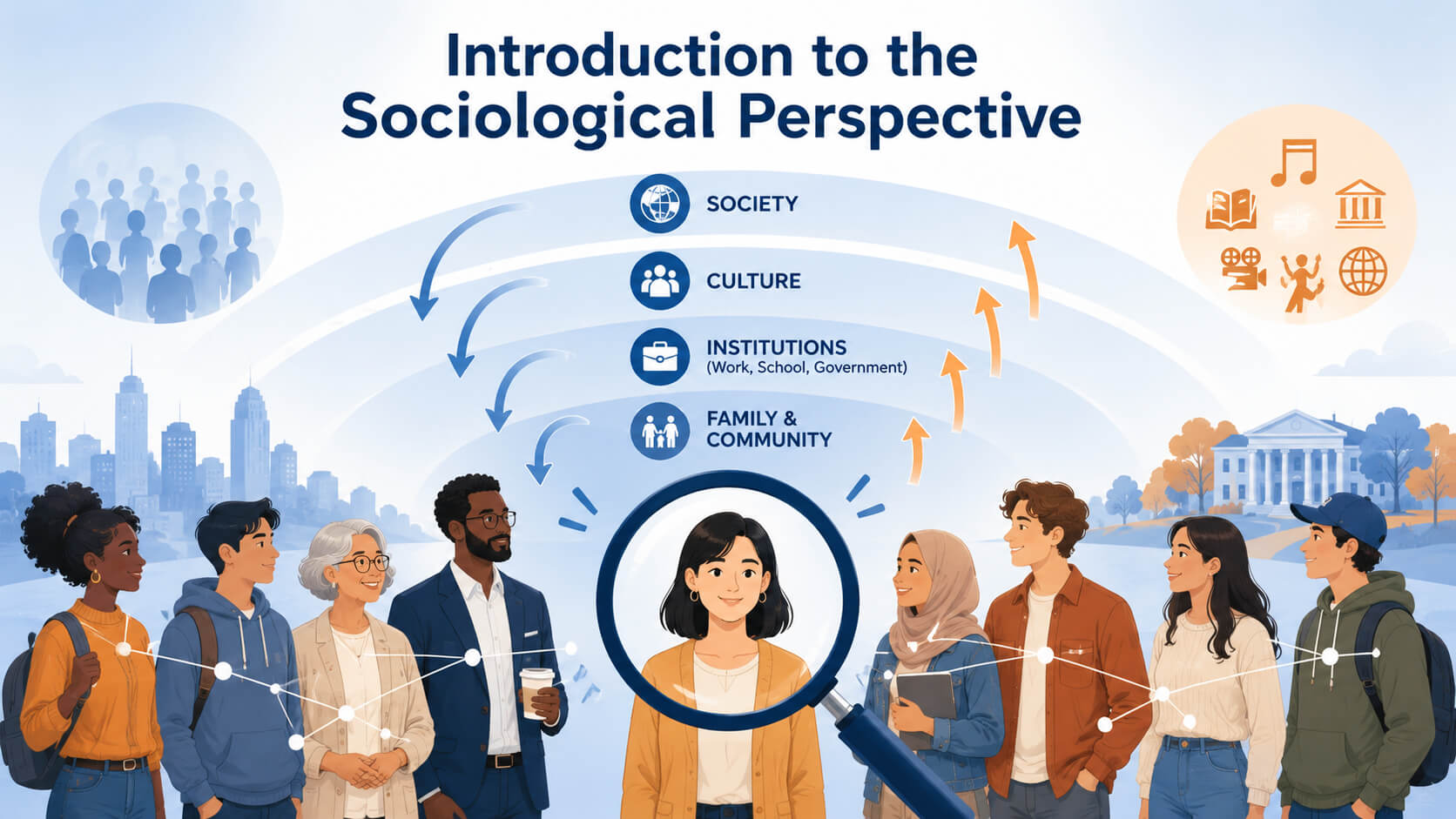
Sociology is the study of society, but more importantly, it is the study of how people live together, interact, and shape each other’s lives. Unlike psychology, which focuses on the individual mind, or economics, which looks at markets and money, sociology zooms out to see the bigger picture of human relationships, institutions, and cultures. It asks: How do families, schools, religions, governments, and everyday practices influence the way we think and act? In this sense, sociology is both a science and a way of seeing—it gives us tools to understand the patterns behind what often feels like random events in our lives.
The Need for a Sociological Imagination
C. Wright Mills famously said that sociology requires a “sociological imagination.” This means learning to connect our personal experiences with larger social forces. For example, if a student feel stressed about exams, it’s not just about their individual anxiety—it’s also about the education system, competition, expectations from family, and the job market waiting outside the university gates. The sociological imagination helps us see that our private troubles are often linked to public issues. It’s like putting on a new pair of glasses that reveal hidden connections between our lives and the wider world.
Distinguishing Sociology from Common Sense and Everyday Knowledge
At first glance, sociology might seem like common sense—after all, everyone has opinions about society. But common sense is shaped by tradition, culture, and personal bias. It often accepts things as “normal” without questioning them. Sociology, on the other hand, insists on evidence, comparison, and critical thinking. For example, common sense might say that “boys are naturally better at math,” but sociology would ask: Is this really about biology, or is it about how boys and girls are taught differently, or how society expects them to perform? By challenging assumptions, sociology moves beyond everyday intuition and helps us see the world more clearly.
In short, the sociological perspective is about learning to question the obvious, connect the personal with the social, and replace assumptions with analysis. It’s the starting point for every sociologist—and for every student who wants to understand not just what society looks like, but why it works the way it does.
C. Wright Mills – The Promise and the Sociological Imagination

The Concept of Sociological Imagination
Mills believed that the greatest gift of sociology offers is the ability to see the connection between our personal troubles and public issues. Imagine a young graduate struggling to find a job. On the surface, it looks like an individual problem—maybe they didn’t study hard enough or chose the wrong subject. But when we apply the sociological imagination, we realize this is tied to larger forces: unemployment rates, economic policies, the structure of the education system, and even global market shifts. Mills called this the intersection of biography and history—our personal stories are always shaped by the wider social and historical context.
Critique of Abstracted Empiricism and Grand Theory
Mills was critical of two dominant trends in sociology during his time.
- Grand Theory: lofty, abstract ideas that sound impressive but are disconnected from everyday life.
- Abstracted Empiricism: endless data collection and statistics without asking meaningful questions.
He argued that both approaches miss the point. Sociology should not be about jargon or numbers for their own sake—it should be about understanding real people’s lives. For Mills, the discipline must stay grounded in lived experience, asking questions that matter to ordinary people.
The Promise of Sociology
The “promise” Mills spoke of is that sociology can empower individuals. By learning to see how personal struggles are linked to structural forces, people stop blaming themselves alone and start recognizing the bigger picture. This awareness is liberating—it gives us the ability to question, to resist, and to imagine change. Sociology is not just an academic subject; it is a tool for critical awareness and social transformation.
In human terms, Mills is telling us: You are not alone, and your problems are not just yours. They are connected to the way society is organized. Once you see that, you gain the power to understand your world more deeply and to challenge it when necessary. That is the true promise of sociology.
Peter L. Berger – Sociology as Consciousness
Sociology as a Form of Consciousness
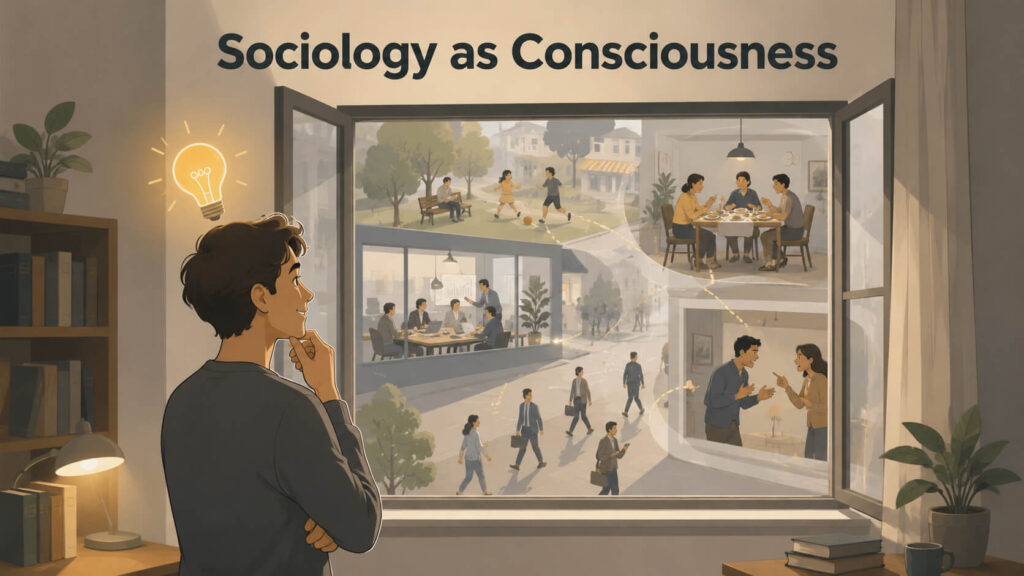
For Berger, sociology is not just a subject you study in class—it’s a way of seeing the world differently. He called it a form of consciousness, a sharpened awareness that helps us notice patterns beneath everyday life. This is what he meant by seeing the “general in the particular.” For example, when you watch a wedding ceremony, you might think of it as just two people celebrating love. But sociology asks: What social rules are being followed here? How do traditions, religion, and family expectations shape this event? Suddenly, what looked like a personal moment became part of a larger social script.
This perspective also teaches us to look beyond appearances. Things are rarely what they seem on the surface. A classroom, for instance, is not just about teaching—it’s also about discipline, hierarchy, and reproducing social values. Sociology helps us peel back the layers and see the deeper forces at play.
Debunking Motif
Berger famously described sociology as having a “debunking motif.” That means sociologists are professional myth-busters. They don’t accept social stories at face value; instead, they dig into the hidden truths. For example, society often tells us that success is purely about talent and hard work. Sociology reveals that success is also shaped by class background, access to education, and social networks.
In this way, sociology unmasks social myths and ideologies, exposing the structures of power and inequality that lie beneath. It shows us how caste, gender, class, or race can quietly shape opportunities and outcomes, even when society pretends everyone has equal chances.
Sociology and Human Freedom
For Berger, the ultimate value of sociology is freedom. By becoming conscious of the hidden rules and forces shaping our lives, we are no longer trapped by them. This awareness is liberating—it allows us to question traditions, challenge inequalities, and imagine alternatives.
He described the sociologist as a “professional debunker”—someone whose job is to strip away illusions and reveal reality. While this can be uncomfortable (because it forces us to confront truths we might prefer to ignore), it is also empowering. Once we see the world clearly, we gain the freedom to act differently, to resist, and to change.
In human terms, Berger is telling us: Don’t just accept the world as it appears. Learn to question it, uncover its hidden structures, and free yourself from assumptions that limit your thinking. Sociology is not just about studying society—it’s about waking up to it.
André Béteille – Sociology as Common Sense
Distinction Between Sociology and Common Sense
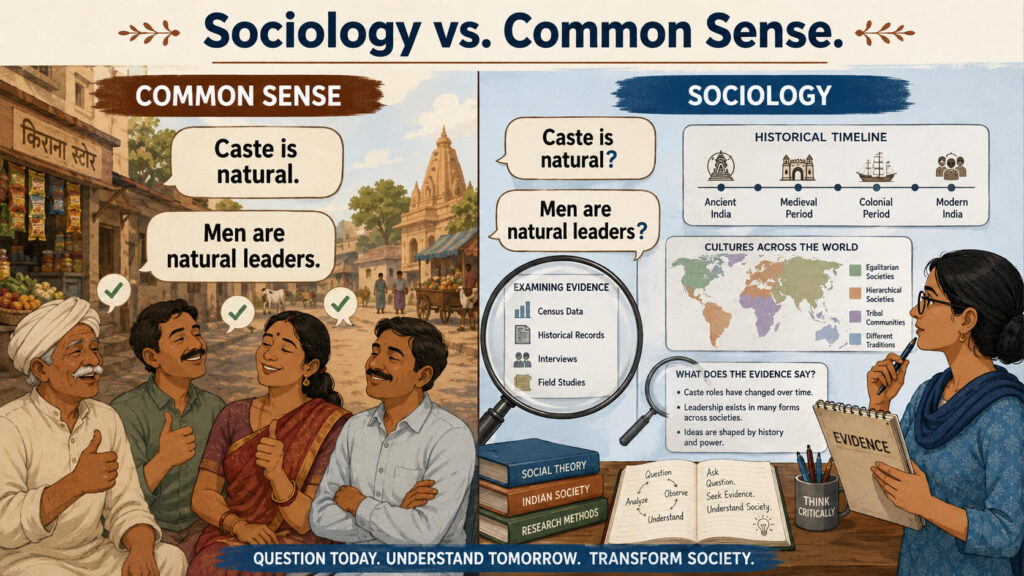
Béteille reminds us that while everyone has opinions about society, not all opinions are sociology. Common sense is shaped by culture, tradition, and everyday experience. It is often fragmented, uncritical, and bound to the values of the community we live in. For example, common sense in India might say, “Caste is natural” or “Men are better suited for leadership.” These ideas feel obvious because they are repeated in daily life, but they are not necessarily true.
Sociology, on the other hand, is systematic, comparative, and analytical. It doesn’t accept things at face value. Instead, it asks: How did caste evolve historically? How do gender roles differ across societies? What evidence supports or challenges these assumptions? In this way, sociology moves beyond intuition and provides a disciplined way of understanding social reality.
Methodological Rigor
For Béteille, sociology must be more than everyday observation—it requires methodological rigor. That means using clear concepts, categories, and evidence to study society. Where common sense might say, “The poor are lazy,” sociology would collect data, compare across groups, and analyze structural causes like unemployment, education, or inequality.
This disciplined inquiry ensures that sociology is not just opinion but a science of society. It demands that we test assumptions, challenge biases, and ground our conclusions in research rather than personal belief.
Sociology in the Indian Context
Béteille’s reflections are especially powerful when applied to India. He studied caste, class, and inequality, showing how deeply they shape everyday life. Common sense often normalizes caste hierarchies or gender roles, but sociology exposes them as social constructions that can—and should—be questioned.
The challenge, however, is that sociologists themselves are part of the culture they study. Separating analysis from cultural bias is difficult. For instance, when studying caste, it is easy to slip into moral judgments or personal experiences. Béteille insisted that sociology must remain objective, even while dealing with sensitive issues.
In human terms, Béteille is telling us: Don’t confuse what “everyone knows” with what is true. Sociology demands that we step back, ask hard questions, and rely on evidence rather than assumptions. In India, this means confronting deeply rooted ideas about caste, class, and gender—not to dismiss them casually, but to understand them critically and fairly.
Comparative Insights
Mills vs. Berger: Imagination and Consciousness as Complementary Lenses
C. Wright Mills and Peter Berger both wanted sociology to wake people up, but they approached it differently. Mills gave us the sociological imagination—the ability to connect personal troubles with public issues. Berger offered sociological consciousness—a sharpened awareness that helps us see beyond appearances. Together, they are like two lenses on the same pair of glasses. Mills help us zoom out to see the big picture, while Berger helps us zoom in to uncover hidden meanings. For example, Mills might explain student unemployment by linking it to economic structures, while Berger would show how society disguises inequality under the myth of “merit.” Both perspectives complement each other, giving us a fuller, richer view of social reality.
Berger vs. Béteille: Debunking vs. Disciplined Critique of Common Sense
Berger saw sociology as a debunking discipline—its job is to strip away illusions and expose hidden truths. Béteille agreed that sociology must challenge assumptions, but he emphasized the need for methodological rigor. Where Berger might boldly unmask myths about caste or class, Béteille would insist on careful evidence, systematic comparison, and disciplined analysis. In this sense, Berger is the passionate myth-buster, while Béteille is a cautious scientist. Together, they remind us that sociology must be both fearless in questioning and precise in its methods.
Mills vs. Béteille: Linking Biography-History vs. Methodological Rigor
Mills wanted sociology to connect biography and history, showing how individual lives are shaped by larger social forces. Béteille, meanwhile, stressed the importance of disciplined inquiry—concepts, categories, and evidence. Mills gives sociology its human urgency, while Béteille gives it its scientific backbone. For example, Mills might highlight how a farmer’s struggles are tied to national agricultural policies, while Béteille would carefully analyze caste and class structures shaping rural society. One provides the vision; the other ensures the vision is grounded in solid research.
Conclusion
1. Sociology as Imagination, Consciousness, and Critique
When we bring Mills, Berger, and Béteille together, sociology emerges as a discipline of imagination, consciousness, and critique. It is imaginative because it connects personal lives to broader structures. It is conscious because it reveals hidden meanings beneath everyday appearances. And it is critical because it refuses to accept common sense without evidence.
2. The Role of Sociology in Questioning Assumptions and Expanding Awareness
Sociology’s greatest role is to make us question what we take for granted. It asks us to look beyond surface explanations, challenge myths, and see the structures shaping our lives. This expanded awareness is not just academic—it changes how we live, how we relate to others, and how we imagine society’s future.
3. Relevance for Contemporary Indian Society and Students
For students in India today, these perspectives are especially relevant. Mills helps us see how personal struggles—like unemployment or exam stress—are tied to larger systems of economy and education. Berger teaches us to question myths around caste, gender, and merit. Béteille reminds us to study these issues with rigor, avoiding bias and relying on evidence. Together, they equip students not just to understand society, but to challenge it, rethink it, and perhaps even transform it.
In human terms, sociology is an invitation: to imagine, to question, and to see clearly. For students, it is not just a subject in the syllabus—it is a way of living with awareness in a complex, changing society.
Suggested Readings
Mills, C. W.- “The Promise” in The Sociological Imagination. Page. 3-24
Subscribe to keep reading
You've used your free notes for now. Get Delhi Pathshala Premium for unlimited access.
Subscribe — ₹29/30 days